

Human Harmonization
Developing on this Page.... Ideas on how the topics in this site; scientific developments and overarching technocracy - are changing the natural state of humanity, and leading away from a natural relationship with the planet: ...with thoughts by philosophers, artists, writers, poets and scientists, and in separate Posts under 'Philosophy'.
Mankind nowadays is arguing how far technology, and in what direction it should go. In the age of genetic manipulation, this must be the burning question of the era; the changing of humans. Human biology is now being manipulated with synthetic technology which will change the epigenetics of humanity. This is a move towards trans-humanism (the dream voiced by some controlling AI developers). This may reduce natural intelligence rather than augment it!
Current direction of science is much about altering the planet and humans. The sprayed atmosphere, The Dimming (spraying to dim the sun), the Earth and human bodies, are all under attack. Space travel and understanding the cosmos, as well as research in micro biology is one thing, but much of the science applied to medicine, especially vaccines is being proven dangerous, while natural medicine has been curtailed, if not out rightly banned.
*****************************************************
PHILOSOPHER and environmentalist, Daniel Schmachtenberger sees the holarchy of world issues - a combination of connected holons of separate issues.
In discussion with Nate Hagens, Daniel delves deep into the root causes of ignorance and psychopathic misunderstandings promulgated from rulers over media, and abounding within the population like a mass psychosis. He is very articulate in a manner which shows the many branches of the issue: humanity and environment run amok. He has developed a dialogue which unites the issues and is aware of the need for holistic thinking by many more.
Daniel discusses how its necessary for more people to understand situations from multiple viewpoints, rather than single issues such as orangutans in a forest being burned and cut, or social justice in a ghetto. People can develop a false sense of esteem, a 'false certainty' he terms it. Within a group falsely certain people can't navigate well, as its hard to sit in uncertainty of not agreeing wholly with the 'in group'. It takes time to go through other people's sense making. None of the issues are getting better, so there's something about deeper structures, which we cannot solve.
"Certainty and esteem are getting hijacked for political warfare." "One marshmallow reward circuit!"
(People are kept focussed on one issue through media propaganda, and government offer new solutions: problem - reaction - solution)
We can relate to that from the current censorship of people being 'certain' something is wrong and not being permitted to express the common sense philosophy behind an issue.
"If you want an open society democracy, everyone participating in choice making, then it demands everyone to do a good job of sense making and meaning. Minimum requirement is authentic deep informed-ness about the nature of the issues, also adequate educativeness."
Daniel often talks about AI, but here it is not so much about AI takeover focus, but how isolated problems (specific environments, specific people) should be viewed as part of the bigger problem. Problematic issues are all holons within the broad holarchy. Within each problem people don't see the bigger picture, and most populations don't see the bigger connected picture.
Evolutionary Psychology
Nate: In the metacrisis, "we are bombarded by things not relevant to our future, either calorifically or mentally. More people are recognising this."
Daniel: "Evolutionary relevant work got rewards previously. (work efforts which created civilisation). Nowadays many jobs are not part of an evolutionary development, nor do they have any shared sacred cultural meaning. "There are often no deeper fillers in our culture. Real relationships (as opposed to social media) force us to become a better person."
“Evolutionary psyche is very riddled”. “Its easy with reductionism to say ‘hey here’s that gene that correlates to something’ ”
"Key to reductionism. Convert the self organising nature of nature to some taxonomy that you can separate. When that happens we can't optimise for a part which is outside our domain of study. Disease gets looked at in this way. If a problem is looked at in isolation, the problem goes somewhere else. Specialisation is part of the problem.
Interconnectivity
Daniel references ideas of a fragmented consciousness from David Bohm who needs to see interconnectivity of whole thing; one person as a separate thing is a delusion: and Krishnamurti's idea to observe without evaluation. [Add related videos] Krishnamurti channel.
Bohm's ideas on interconnectivity: Thoughts have Shape and Power'. A recent, charming, independent, image based short video about how intention can blend outwards influencing the outer world of form; inspired by Bohm's thoughts on the quantum world, where the observer is part of the observed.
Daniel refers to Vedic philosophers, the Bhagavad Gita: Chapt 2, vs 48
‘Yoga’ means union with all that IS “yogasha kui karmani” is the quote.
"...from the place where you recognise that your existence doesn't exist without everything else, and from the place where you cognitively but also experientially get that, where there’s an intimacy with all life, and act from there...
Spontaneous right action emerges from that place. Sacredness of all life and unity of."
Both Daniel and Nate agree they find sacredness of life in nature and being in the natural environment. The sublime experience needs to be put across to people. Nate wonders how this gets communicated to people. City people might not have such an intense appreciation. Daniel says he has decided to be more involved in attitude of hope, love and assertion, rather than catastrophism against all the issues. (a great turn around from his ideas as a teenager, when he felt quite desperate, which he explains in the video.)
My site Resonant Visions is an attempt to show and discuss the aspects of sublime nature; not only naturally beautiful landscape scenery and flowers, but aspects about frequency; including some early scientific studies on the aspects of 'natural forces' such as Walter Russel, Dan Winters, Viktor Schauberger. (In development)
The disharmony Nate and Daniel discuss are all problems which could be alleviated if people in power made better decisions. "Its a minority who think about theory of governance" says Daniel.
These issues are discussed in Carey G Butler's 'Puberty of the Human Mind'. He also works with holons and holarchies as interconnectivities expressed through groundbreaking mathematics: Agency, Communion, Transcendence, Dissolution, Interiority, Exteriority. [Link?]
*****************************************************************
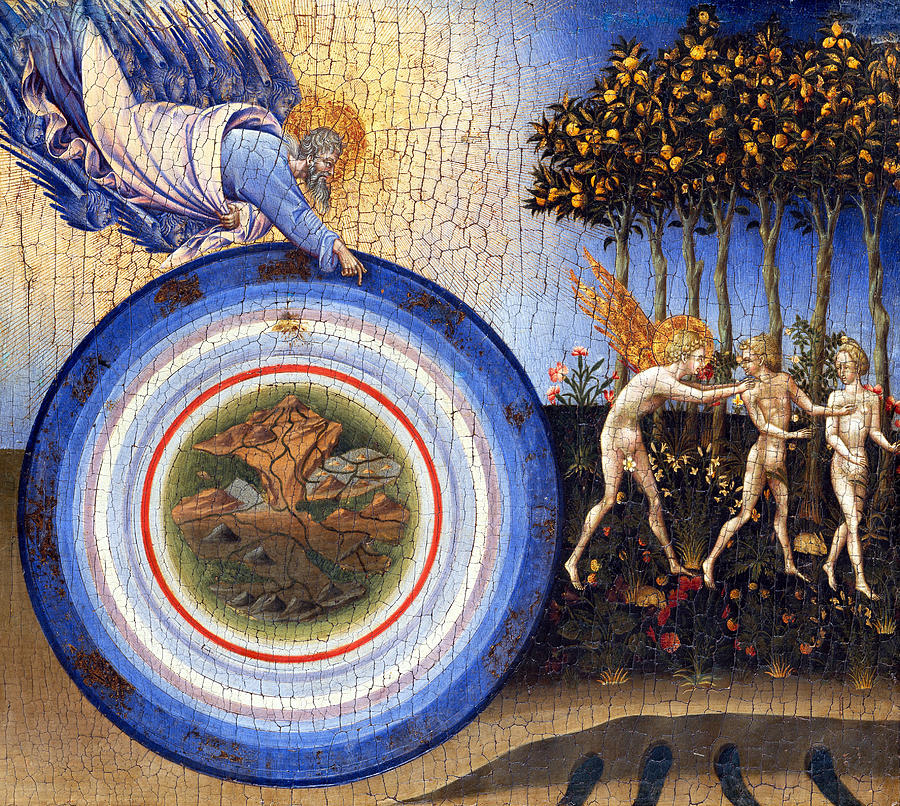
The Creation of the World and the Expulsion from Paradise by Giovanni de Piolo - Depiction of extraterrestrial 'god' (Enlil) expelling the hybrid humans from 'Edin' (Eden in biblical text). Source: Fine Art America
True or not, we can't know, but now that genetic engineering has reached such a capability it proves the possibility. One could even wonder if there are different types of humans on the planet; some whose minds determine them to act in evil ways and other innocents who live harmoniously. Thats why the topic of The Garden of Eden, or an original 'golden age' is popular amongst those considering the state of humanity currently. With so much forced death and destruction instigated by those in powerful positions its difficult to understand why some authorities acting over humankind have developed one way, destructively; whereas most people strive to live harmoniously. Our world today is the result of controlling monetary and military powers; nothing much different from Roman times.
The subject of genetic manipulation, one of the most humanity-changing scientific developments, may not be new. Ancient history describes visiting 'gods' Enlil and Enki disagreed on the purpose of their new genetically created version of people. Enlil the commander on Earth was determined to use only the first synthesis of Anunnaki+Homo Sapiens, which had taken many thousands of years to develop, even to basic success, to be slaves on Earth. Enki the engineer, however was proud of the new creation and after further perfecting the gene development balance (through his own offspring) with higher proportion of Anunnaki 'essence', he taught the hybred well and took them to the elites' command base (Edin) to learn more, which infuriated Enlil who, although wanting the first incarnation as slaves, was opposed to advancing the species too fast, acting against evolution. Enlil cast the visitors out of the 'Garden of Edin' (Eden) because they had taken of the tree of knowledge! Not knowledge of evil, as we are led to believe, but higher knowledge.
****************************************
Illustration promoting the Royal Society.
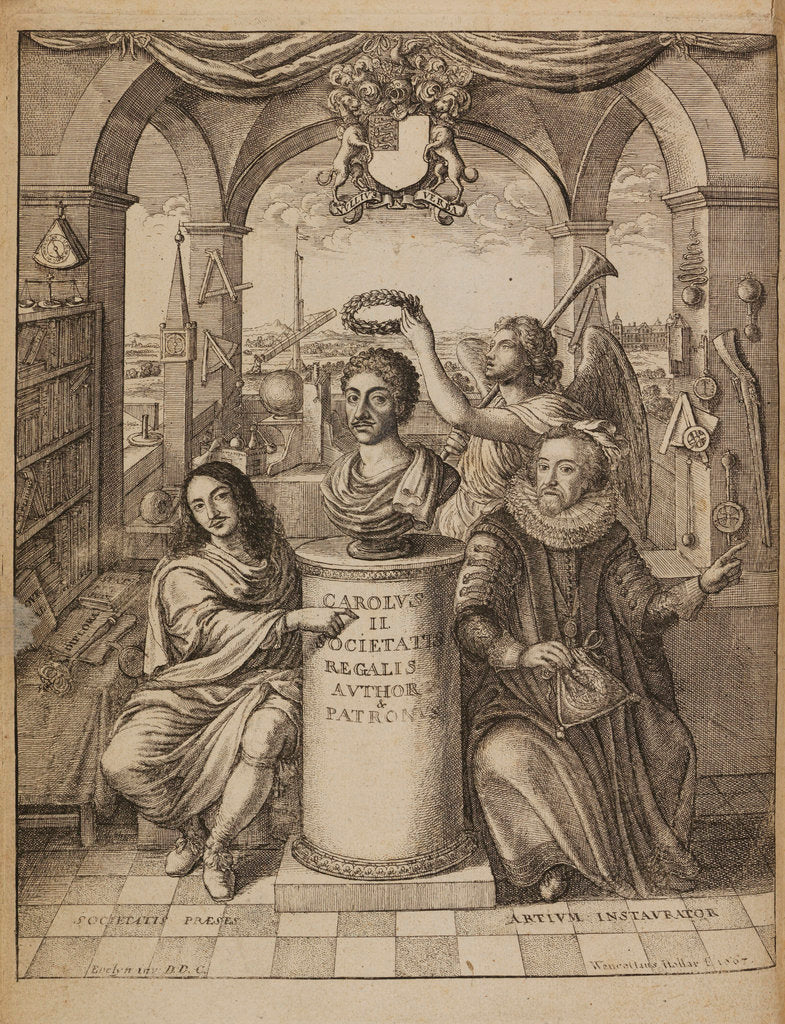
The science we have today, which many say is reductionist more than visionary, started by the Royal Society, who cobbled themselves together from both sides of the English Civil War, and headed up by Frances Bacon and sanctioned by King Charles II. Many details of members in Spratt's 1667 book History of the Royal Society.
P. 6
‘It was the custom of wise men to wrap up their observations on nature and the manners of men, in the dark shadows of hieroglyphics, and to conceal them, as sacred mysteries, from the apprehensions of the vulgar. This was a sure way to beget a reverence in people’s hearts towards themselves : But not to advance the true philosophy of nature. That stands not in need of such artifices to uphold its credit: But is then most likely to thrive, when the minds and labours of men of all conditions, are joined to promote it, and when it becomes the cure of unity nations. ‘
And from Freemasonry and the Birth of Modern Science by Robert Lomas
The Royal Society was born of twelve disparate and ill-assorted men, meeting on a cold November afternoon in the rooms of the Professor of Geometry at Gresham College in London. At first sight they seem to share nothing beyond a degree of wealth (to afford the fees) and a curiosity about the workings of nature. But as I started to investigate these men I soon found that they formed two clear groups; and these groups had no reason to even like each other, let alone to wish to meet for regular scientific tea parties. And, some of them were far from wealthy. These founding twelve differed in terms of politics, scientific expertise and social rank. They formed a very strange political mix indeed.
[Add: direction of science from Alchemy - pharmaceuticals]
****************************************************
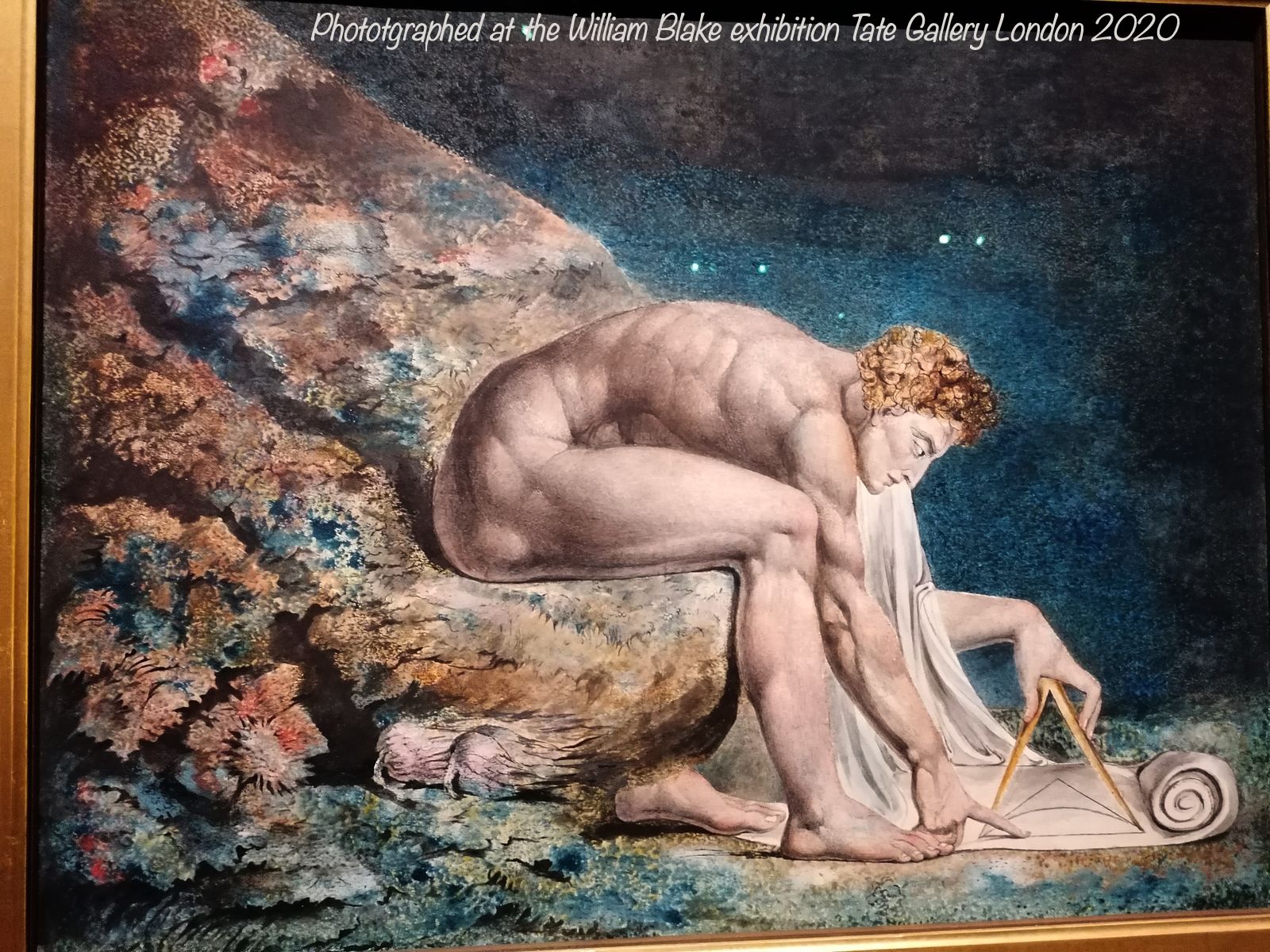
Blake's painting deliberately shows Newton under the sea; symbolic (to Blake), of his being unaware of part of the universe. The great French philosopher Voltaire would remark, “we are all now disciples of Newton”.
William Blake wasn't keen on the Royal Society's obsession with scientific measurements, as he believed other aspects of knowledge were being ignored. We know today he meant the direction of science angled purely towards measurement, leading to reductionism, which we see today still is the case: while other knowledge based on human intuition, and unseen invisible frequencies, now termed morphic resonance, were worthy of exploration. As a visionary, Blake was well placed to make this observation, which resonates today. Blake is specifically interesting to study, because of his interest in politics, as well as the direction of science and rapidly changing industrialisation of his era. It was not long afterwards that the anti industrial movements of John Ruskin and William Morris and The Arts & Crafts Movement would develop... Blake gravely noted:
"They were all asleep... intent on reducing the divine relationships and character to straight lines, parabolas, and ratios".
Meaning and sacredness of human life and the planet's natural state are reduced more and more. That emptiness is filled for some by following socially engineered protesting about 'climate change', giving a false meaning to life; as Danial Schmachtenberger terms a 'false certainty'.